


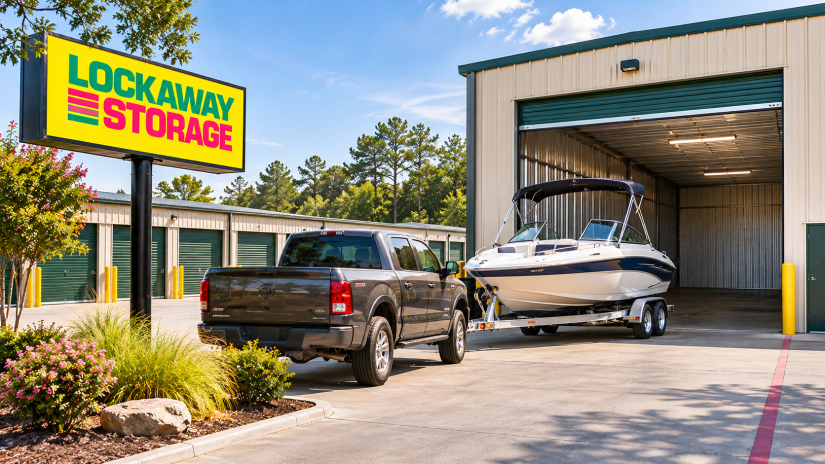


RV and Boat Storage in Willis, TX: What Fits in a 14x50 Enclosed Unit
Anyone who keeps a boat, travel trailer, or RV on the west side of Lake Conroe eventually runs into the same problem. The driveway works fine until the HOA sends a letter, or the trailer tongue starts blocking the garage, or the thing just will not fit behind the house anymore. Willis sits close enough to the lake that a lot of that gear never goes far when it is not in use, which is exactly why the question is not whether to store it but where it actually fits.
At a Glance
Lockaway Storage Willis has one enclosed 14x50 drive-up unit built for RVs, boats, and trailers, along with standard 10x5 drive-up and 10x5 and 10x10 climate-controlled units for everything else.
Willis sits off TX-75 on the west side of Lake Conroe, with sister Lockaway locations in Conroe and Montgomery offering covered and outdoor boat and RV parking as additional options nearby.
Enclosed Is a Different Deal Than Covered or Outdoor
Three different parking setups get lumped together as RV storage, and they are not interchangeable. Outdoor parking is a slab and nothing else, which works for a utility trailer or a boat that gets washed every weekend anyway. Covered parking adds a roof, which cuts down on sun bleaching and keeps the worst of the rain off a fiberglass hull or a trailer's wiring harness, but the sides stay open to blowing dust and pollen. Enclosed parking, which is what Willis offers in its 14x50 unit, closes the vehicle in on all sides the same way a drive-up storage unit does.
That matters most for anything that sits for months at a time between uses. A bass boat that gets taken out every other weekend does fine under cover. A travel trailer that only comes out for two trips a year, or a pontoon boat that gets winterized and parked from October through March, benefits more from being fully enclosed, since nothing is working its way in through gaps in a roof panel.
Doing the Math on What Fits in 14 by 50 Feet
A 14 by 50 foot footprint sounds enormous until a real vehicle gets measured against it. Most single-axle bass boats on a trailer run 18 to 22 feet bow to trailer tongue, which leaves 28 to 32 feet of slack, plenty of room to also tuck a smaller trailer or a stack of dock equipment in alongside it. A pontoon boat and trailer typically lands between 24 and 28 feet, still comfortable inside 50 feet with room to walk around the sides.
Travel trailers are where the math gets tighter. A standard bumper-pull travel trailer runs 25 to 32 feet, and a fifth wheel commonly stretches 32 to 40 feet once the hitch and bumper are included. Either fits inside 50 feet of length, but the 14 foot width is the number to check first, since most travel trailers run 8 to 8.5 feet wide including the awning box, and a dually truck or a wide-mirror tow vehicle can eat into that margin fast if it is being stored alongside the trailer rather than just used to haul it in.
Class A motorhomes are the one category worth measuring twice. Many run 35 to 40 feet, which still clears the 50 foot length, but height is the variable that is easy to miss on paper. A unit's listed ceiling height should always get confirmed against the actual motorhome, including roof-mounted air conditioners and satellite domes, before assuming anything over 12 feet tall will clear.
Smaller gear gets overlooked in this math and should not be. A single or double jet ski trailer runs 10 to 14 feet and barely registers against 50 feet of length, which means it almost always makes sense to store one alongside a boat or RV in the same unit rather than renting a second space just for it. A utility or cargo trailer used to haul the jet skis or dock equipment typically runs 12 to 20 feet and fits the same way. The real planning question is rarely whether any single item fits. It is whether two or three items fit together with enough room left to actually open doors, drop a tailgate, or back a trailer out without a three point turn inside the unit.
Getting a Boat or RV In Before Lake Conroe's Season Starts
Lake Conroe is one of the larger lakes in the region, with the San Jacinto River Authority putting its surface area at roughly 20,000 acres at normal pool. That size is exactly why boat traffic on it swings so hard by season. Spring means launch day traffic backs up at the ramps closest to Willis and north Montgomery County, and a boat that is still winterized in a driveway on the first warm weekend of March is a boat that misses it.
The better pattern is moving storage timing around, not just the boat itself. Getting a boat into an enclosed unit in October or November, once the season has clearly wound down, means it comes out again in spring already protected from the worst of the winter weather swings, rather than sitting exposed in a driveway through freezes and thaws. The same logic runs in reverse for a travel trailer that only gets used for summer camping trips. Moving it in right after Labor Day weekend beats letting it sit hitched in the yard until the first cold snap forces the issue.
Montgomery County does not get the hard freezes that make winterizing a boat or RV mandatory the way it is further north, but it still swings through enough cold snaps most winters to matter for anything with water lines or a fiberglass hull sitting exposed. A few nights near or below freezing each winter is usually enough to crack a water line that was not drained, or to stress gel coat that has already taken a summer of direct sun. An enclosed unit does not replace draining the lines and running antifreeze through the system before winter, but it does remove the direct exposure that makes a borderline freeze actually dangerous for the vehicle.
What Else Ends Up Stored Alongside the Boat
A boat or RV rarely travels alone when it comes to storage. Life jackets, dock lines, fishing rods, folding chairs, coolers, and the dozen other things that live in a boat during the season all need somewhere dry to sit once the boat itself goes into an enclosed unit for the winter. Keeping that gear loose in a garage usually means it gets damp, dusty, or simply buried behind whatever else accumulated over the summer.
This is where the climate-controlled 10x5 and 10x10 units at Willis do real work that the vehicle unit was never meant to handle. A 10x10 holds a season's worth of lake gear, folding furniture, and camping equipment with room to spare, and keeps it at a steadier temperature and humidity level than an uninsulated garage does through a Texas summer. For a household that also uses the 14x50 for a boat or trailer, renting both units at the same facility means one trip in spring to collect everything rather than digging through a garage for the gear and driving separately to the storage unit for the boat.
When Willis Makes More Sense Than Driving Toward the Lake
Lockaway Storage has locations closer to the water itself, including Lockaway Storage Lake Conroe, which is built specifically around boat and RV parking with a private dock and launch. For someone who lives on the Montgomery side and keeps a boat in the water most of the season, that location is often the better fit.
For Willis residents and anyone north along TX-75, though, driving a trailer another 20 to 30 minutes toward the lake just to store it defeats some of the convenience. Keeping the boat or RV close to home at Lockaway Storage Willis means less towing distance both for drop-off and for the actual trip to the ramp, and the climate-controlled units on the same property give the rest of the household's gear, life jackets, fishing tackle, camping equipment, a dry place that does not need its own towing math.
Anyone weighing covered versus outdoor parking at the lake-adjacent locations can get a fuller breakdown in Lockaway's guide to boating season around Lake Conroe, which covers the ramp and launch side of the picture this article does not.


